
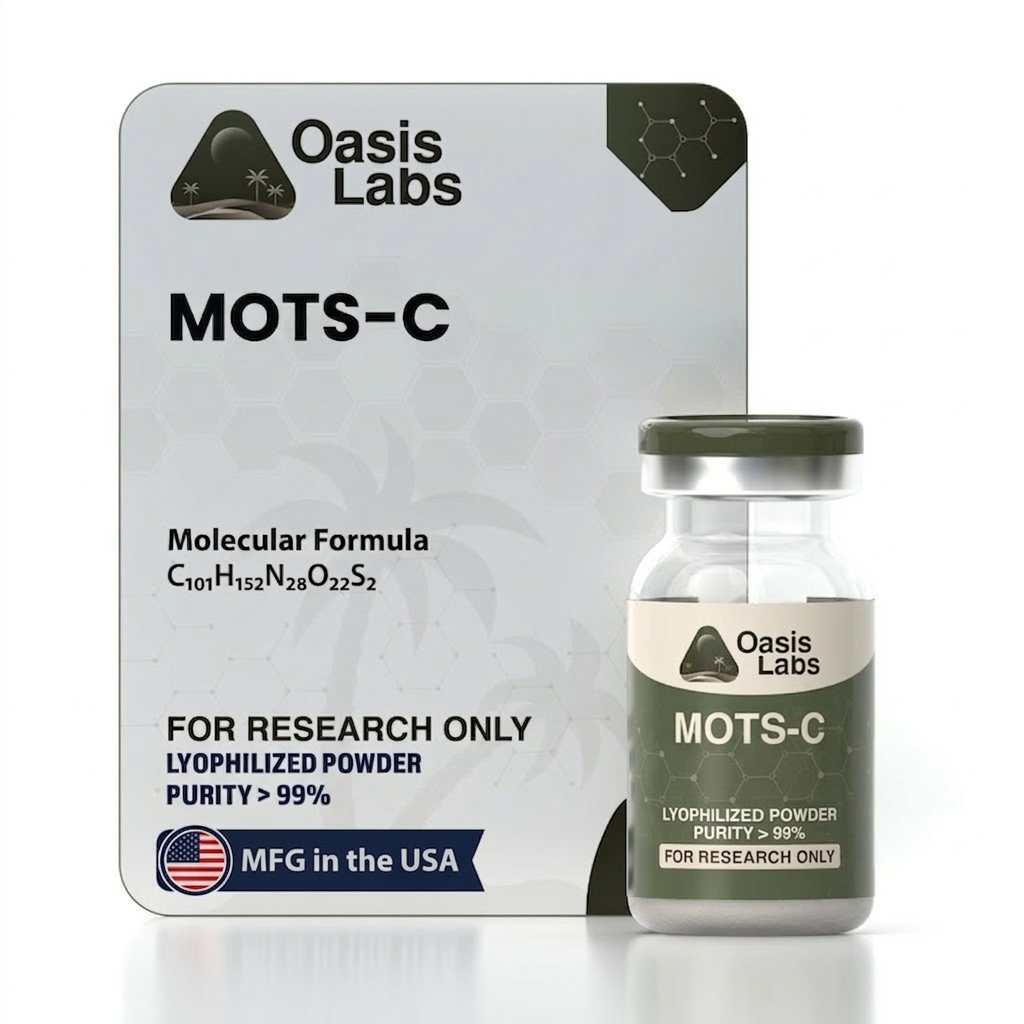
MOTS-c was first identified in 2015 by researchers at the University of Southern California. It travels from the mitochondria to the nucleus (where it influences how genes related to metabolism), stress response, and inflammation get expressed. MOTS-c degrades faster than most peptides (so cold-shipped), third-party-tested material matters more here than usual — Ascension’s MOTS-c 10mg is the vial most of the protocols below are run on. Most guides on MOTS-c peptide either bury the practical details under science jargon or skip the nuances that actually matter for people using it. FDA said potential risks in humans are unknown, and the lack of reported side effects reflects the lack of human studies.
This guide is designed to help laboratory researchers navigate the MOTS-c supplier landscape intelligently, know what documentation to require, recognize red flags, and make purchases that support sound science. This guide is for researchers evaluating supply options for legitimate scientific use. MOTS-c activates AMPK and regulates metabolism systemically. While MOTS-c activates similar metabolic pathways , AMPK, glucose uptake, fat oxidation,, it does not replicate cardiovascular adaptation, neuromuscular development, bone loading, or the psychological benefits of exercise.
Known MDPs also encompass Humanin along with small humanin-like peptides , SHLPs 1 to 6,. Mitochondria produce MOTS-c (classifying it as part of a limited group known as mitochondria-derived peptides), or MDPs. Genes located in the cell nucleus typically generate the majority of biologically active peptides.
This suggests that MOTS-c and similar peptides could have significant implications for research into extending lifespan and improving health in humans by targeting mitochondrial function. Dr. Changhan David Lee (a researcher at USC Leonard Davis School of Gerontology), highlights the importance of mitochondrial biology in research into extending lifespan and healthspan in humans.

These products exist in a regulatory gray zone and come with no clinical evidence of efficacy or safety in humans. Researchers studying Asian centenarians found that these individuals were more likely to carry a particular variant within the stretch of mitochondrial DNA that encodes MOTS-c, suggesting that the version of MOTS-c a person produces could influence lifespan.23Diabetes & Metabolism Journal. One of the reasons MOTS-c attracts attention beyond its metabolic effects is a genetic observation in exceptionally long-lived people. The mechanism appeared to involve calming overactive immune cells in the brain , astrocytes and microglia, and reducing the inflammatory molecules they produce.22PubMed.
Due to the limited number of human clinical trials, the benefits for individuals remain unverified. Inside the mitochondria, which serve as the energy centers of the cell, MOTS-c is generated. Improvements in fat loss (energy levels), and insulin sensitivity are usually noticeable within a period of 3 to 4 weeks. For longevity protocols, continuous use is favored over cycling.
A Timeline of Scientific Discoveries
” becomes increasingly relevant to understanding the future of biomedical research and therapeutic development. As scientists continue to uncover the mysteries of this mitochondrial-derived peptide, the question “Why do people research MOTSC peptides? Have you ever wondered what drives researchers worldwide to dedicate countless hours studying a 16-amino acid peptide that was only discovered in 2015? Your body also produces MOTS-c endogenously, and regular exercise increases this natural production. Exogenous MOTS-c effects fade over 2-4 weeks as the peptide clears. The peptide does not produce overnight transformations.
What MOTS-c is studied for
These inquiries are focused on mechanisms in laboratory research — rather than established applications in humans. Researchers provide straightforward explanations regarding their studies — detailing neither product effects on individuals nor serving as medical advice. Researchers investigate MOTS-c due to its role in transmitting mitochondrial stress signals to the nucleus, particularly in the context of aging and the decline of mitochondrial function. The study of MOTS-c involves its relation to skeletal muscle and physical stress, including the signaling associated with muscle atrophy. Because energy management underpins much of physiology (researchers have pursued two main areas — AMPK-driven metabolism and stress-adaptive gene regulation — in relation to models of insulin resistance), aging, and muscle biology. In studies involving animals and cells, researchers examine the impact of MOTS-c on metabolism — how cells metabolize fuel — and their responses to physical stress.

Body Weight and MOTS-c
Dosing on training days (or in the hours before a session), follows from that logic, though no human study has ever compared timings. In Reynolds 2021, skeletal muscle from MOTS-c-treated mice showed significant metabolic changes only in animals that had exercised; non-exercised mice showed no significant alteration. The human protocol inherited the 3×/week rhythm but neither the dose nor the route. Run a washout of at least four weeks either way.
Advantages of MOTS‑c for Longevity, Performance, and Metabolic Health
Most protocols run 6-12 weeks on, followed by 4-8 weeks off. Intramuscular injection is sometimes used for performance protocols, but subcutaneous is simpler and appears sufficient for systemic effect. → Chronic daily use may dull metabolic signaling→ Longer cycles , 6+ weeks, haven’t been studied in humans and could backfire Since it’s naturally produced by the mitochondria, side effects tend to be mild, rare, and dose-dependent—especially when compared to other metabolic peptides like MK‑677 or IGF‑1 LR3. MOTs-C (also written «MOTS-c» or «motsc») is a 16-amino-acid peptide encoded within a short reading frame of the mitochondrial genome — the small, separate DNA inside mitochondria — rather than the cell’s nuclear DNA. Most people notice subtle shifts in energy stability and workout quality within 1–2 weeks.
Reconstitution Protocol in Detailed Steps
Refrigerated storage (used within 28 days), is the documented approach. In those protocols — a 1 mg dose corresponds to 20 units on an insulin syringe. At the standard weekly total, a 10 mg vial covers two weeks; a 40 mg vial covers eight weeks.

The peptide’s discovery marked a significant milestone in understanding how mitochondria communicate with the rest of the cell. This 16-amino acid peptide (encoded within mitochondrial DNA), has captured the attention of researchers worldwide due to its unique properties and potential applications. MOTSC (Mitochondrial Open Reading Frame of the 12S rRNA-c) represents a revolutionary discovery in peptide science.
The effects of administered MOTS-C in humans have not yet been verified. The proposed mechanism of MOTS-C arises from preclinical studies and remains unconfirmed for its administration in humans. FDA found no published data on administered MOTS-c in people. Since no published findings exist for the administration of MOTS-C in humans, these are considered proposed uses under examination rather than confirmed effects or endorsements.
They took 25 mg daily via subcutaneous injection for 4 weeks. The Phase 1b trial enrolled 20 obese people with fatty liver disease. People who exercise regularly maintain higher baseline levels than sedentary people. Your body makes MOTS-c naturally, mostly in skeletal muscle. Given how fast MOTS-c degrades — a flat result is a quality problem more often than it’s a real non-response. The people who end up satisfied with it are the ones tracking numbers, not the ones checking the mirror.